


Chrome vs Vegetable Tanning: A Leathercraft Guide to Quality, History, and Sustainability
If you’ve ever wondered why some leather goods age like fine wine while others look the same (or fall apart) after years, the secret often lies in how the leather was tanned. Leather artisans generally distinguish between vegetable tanning (an ancient, natural process) and chrome tanning (a modern, chemical process). Each method produces leather with distinct characteristics, costs, and environmental impacts. In this detailed comparison, we’ll explore the history of both tanning methods, weigh their pros and cons, and offer artisan tips for choosing the right leather for your needs. By the end, you’ll understand why a vegetable-tanned belt might develop a rich patina over decades, while a chrome-tanned jacket stays soft and consistent in color throughout its life.
A traditional open-air tannery in Fez, Morocco, where hides are processed in stone pits using plant-based tannins – a method largely unchanged for centuries. Vegetable tanning like this is slow and labor-intensive, but it yields leather with a natural depth and character. In contrast, modern chrome tanning typically takes place in industrial drums using chromium salt solutions, completing the process in a day instead of months.
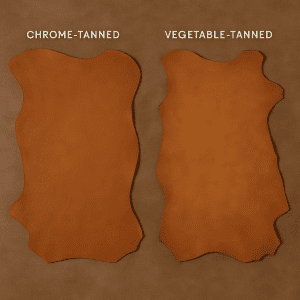
Side-by-side comparison of Chrome-Tanned (left) and Vegetable-Tanned (right) leather, both in the same color, highlighting the difference in texture, finish, and character between the two tanning methods.
Historical Overview of Vegetable and Chrome Tanning
Vegetable Tanning:
Vegetable tanning is one of the oldest leather-making methods, dating back thousands of years. This traditional process uses natural tannins found in barks, leaves, or fruits to cure hides, and it was the dominant method of tanning up until the 19th century. Tanneries across medieval and early-modern Europe would soak hides in vats of oak or chestnut bark solutions for months to create durable leather. The approach is labor-intensive and time-consuming, but it produces leather prized for its durability and rich, earthy character. Because of the lengthy process and craftsmanship involved, vegetable-tanned leather became associated with quality and tradition over time.
Chrome Tanning:
In the mid-19th century, the leather industry experienced a revolution with the invention of chrome tanning. Around 1858, technologists discovered that using chromium salts (especially chromium sulfate) could dramatically speed up the tanning process. Unlike vegetable tannins, which might take weeks or months to fully penetrate a hide, chromium chemicals could stabilize a hide in mere hours. By the late 1800s, chrome tanning spread quickly as tanneries embraced its efficiency. Mass production of leather became feasible – what once took months in veg-tan pits could now be done in a day. Today, chrome tanning accounts for roughly 80–90% of the world’s leather production due to its speed and cost-effectiveness. However, the trade-off has been environmental and aesthetic: the use of toxic chemicals raised concerns about pollution, and chrome-tanned leather, while soft and flexible, doesn’t develop the same patina or longevity as good vegetable-tanned leather.
Chrome vs. Vegetable Tanning – Comparison Table
| Aspect | Chrome Tanning | Vegetable Tanning |
|---|---|---|
| Tanning Materials | Uses chromium salts and other inorganic chemicals. | Uses natural tannins from plant sources (tree bark, leaves, fruits). |
| Tanning Time | Very fast – can tan a hide in a day or two. | Slow – typically several weeks to months. |
| Color & Finish | Any vibrant color possible, uniform appearance, no patina. | Natural earth tones, darkens and develops patina over time. |
| Feel & Flexibility | Soft and supple immediately. | Stiff at first, softens and molds with use. |
| Durability & Aging | Good durability, maintains original look, less improvement with age. | Exceptional longevity, gains character with patina. |
| Cost | Cheaper to produce, lower consumer price. | More expensive due to time and craftsmanship. |
| Eco-Friendliness | Higher environmental impact, toxic waste if untreated. | More eco-friendly, biodegradable, avoids heavy metals. |
Pros and Cons of Each Tanning Method
Vegetable Tanning – Pros
- Natural and eco-friendly: Uses organic tannins with no harmful chemicals.
- Tradition and craftsmanship: An ancient, artisan process requiring skill and care.
- Durability and longevity: Grows stronger and develops a rich patina over decades.
- Distinct character: Each piece gains a one-of-a-kind look over time.
- Moldable and tool-able: Ideal for stamping, carving, or molding.
Vegetable Tanning – Cons
- Slow and costly: Typically takes 30–60 days or more.
- Initial stiffness: Requires break-in period.
- Limited color palette: More muted, earthy tones.
- Water sensitivity: Can stain or stiffen if soaked.
Chrome Tanning – Pros
- Speed and low cost: Can be completed in a single day.
- Softness and flexibility: Ready to use immediately.
- Stable colors and finish: Vibrant and uniform for years.
- Water & heat resistance: Better suited for everyday conditions.
Chrome Tanning – Cons
- Environmental hazards: Produces toxic waste if untreated.
- Shorter lifespan: Does not improve with age like veg-tan.
- Lack of patina: Maintains original appearance, no rich aging.
- Not ideal for certain crafts: Difficult to tool or mold.
Leather Characteristics: How Each Type Looks and Feels
- Feel & Flexibility: Chrome-tanned leather is soft and pliable from day one; veg-tan starts firm but softens and molds to its owner over time.
- Appearance & Patina: Veg-tan darkens and gains luster with use; chrome-tan stays consistent in color.
- Durability & Strength: Veg-tan often lasts decades with care; chrome-tan is durable but not as long-lived.
- Scent: Veg-tan has a pleasant earthy smell; chrome-tan often has a chemical scent initially.
- Water Response: Chrome-tan resists water better; veg-tan is prone to staining unless treated.
Common Uses
Vegetable-Tanned Leather:
- Belts, straps, saddles, and harnesses
- Wallets, structured bags, and briefcases
- Tooling, carving, and molded pieces
Chrome-Tanned Leather:
- Jackets, gloves, and fashion apparel
- Upholstery for furniture and vehicles
- Soft bags, casual footwear, and accessories
Artisan Tips: Choosing the Right Leather
- Match to the use-case: Sturdy, structured items → veg-tan; soft, drapey items → chrome-tan.
- Consider longevity vs comfort: Veg-tan lasts longer, chrome-tan feels comfortable right away.
- Think about sustainability: Veg-tan is more eco-friendly.
- Prioritize aesthetics: For vibrant, uniform colors → chrome-tan; for natural, evolving tones → veg-tan.
- Maintenance level: Veg-tan needs regular conditioning; chrome-tan is more low-maintenance.
- Combine for balance: Use veg-tan for structure and chrome-tan for flexibility in the same product.
Conclusion
Choosing between vegetable-tanned and chrome-tanned leather comes down to your intended use, desired appearance, and values. Vegetable tanning offers heritage quality, patina, and toughness at a higher price, while chrome tanning brings softness, color variety, and affordability. Neither is “better” for all purposes – each shines in its own context. By understanding these differences, you can make informed choices that ensure your leather goods serve you beautifully for years.