


Shell Cordovan: The Luxury Horsehide Leather
Few leathers inspire as much devotion as shell cordovan. Its mirror-like glow, dense hand, and uncanny ability to roll rather than crease have made it the material of choice for connoisseurs of high-end shoes and small leather goods. Shell cordovan is not just “horsehide”—it’s a very specific, oval section from the rump of the horse, treated through an exceptionally long vegetable tanning and finishing process. The result is a leather with no visible grain on the wear surface, extraordinary durability, and a depth of color that seems to shift and pool like wet lacquer. This guide explains what shell cordovan is, how it’s made, why it behaves differently from other leathers, typical uses, and exactly how to keep it looking its best.
What Exactly Is Shell Cordovan?
“Shell” refers to two oval membranes found beneath the grain and flesh layers in the horse’s rump. Unlike cowhide—built from vertical fiber bundles and a surface grain layer—these shells are a dense, horizontally interwoven fiber mass. When tanned and finished, the wear surface you see is the shell itself, not a grain that can pebble or crack. That unique structure explains nearly all of cordovan’s famous characteristics: the mirror polish, the roll instead of a crease, the impressive resistance to stretching, and the uncommon longevity.
Key traits you’ll notice
- No visible grain: a glassy, uniform face when finished.
- “Cordovan roll”: at flex points (vamps of shoes), folds appear as smooth waves rather than sharp creases.
- High density: heavy in the hand, with minimal stretch and excellent shape retention.
- Color depth & glow: dye sits within a tight fiber matrix; surface can be burnished to a true mirror.
How Shell Cordovan Is Made (Step by Step)
While every tannery has its secrets, the broad workflow is remarkably consistent—and slow (often six months or more):
- Selection & Cutting
After hides are received, the rump section is isolated and the two shells are carefully cut from each side. These ovals are relatively small—typically large enough for shoe quarters and small goods, not whole panels for big bags. - Vegetable Tanning (Long and Cool)
The shells are slowly tanned in pits or drums with tree-bark extracts—oak, chestnut, quebracho, and others. Cool temperatures and long dwell times allow tannins to thoroughly penetrate the dense shell. This yields a firm, highly stable substrate. - Hot Stuffing / Waxes & Oils
Once tanned, the shells are stuffed with a proprietary blend of oils, waxes, and greases. This step plasticizes (in the best sense) the fiber matrix, adding lubricity and setting the stage for the signature polish and roll. It also contributes to cordovan’s water resistance and rich, “wet” look. - Shaving & Leveling
Craftspeople shave the shells from the flesh side to a precise thickness, leveling the surface to an even plane. This reveals the shell’s internal face—the part that will become the visible, mirror-finished side in your shoes and wallets. - Dyeing
Shells are aniline dyed—either fully struck through or with layered tones—to achieve classic colors like Color 8 (a deep oxblood), black, whiskey, bourbon, and rare seasonal shades. Because of the dense structure, the resulting color has uncommon depth. - Drying & Setting
Shells are carefully dried flat—often glass-boarded—to maintain a smooth plane and prevent cupping or wrinkling. Slow drying keeps the fibers relaxed and uniform. - Glazing (The Mirror)
The hallmark shine is built by glazing the shell with glass, agate, or steel tools—literally pressing and burnishing the tight fiber surface until it takes on a lacquer-like gloss without heavy topcoats. Multiple passes, with rests between, refine the face to that unmistakable mirror. - Condition & Rest
Finally, shells are oiled, polished, and rested so oils/waxes equilibrate. This “cure” gives cordovan its signature hand and long-term stability.
Why Shell Cordovan Behaves Differently
- No grain to break: Because you’re not flexing a grain layer, the leather rolls smoothly rather than cracking or micro-creasing.
- High fiber density: The compact structure resists stretching, keeps shoes from bagging out, and lets small goods keep crisp edges for years.
- Finish by compression: The mirror isn’t spray lacquer; it’s mechanical glazing of fibers. With maintenance, that surface can be refreshed repeatedly.
Pros
- Extraordinary longevity (decades with resoling for shoes).
- Superb color depth and mirror potential.
- Shape retention and minimal stretching.
- Patina that becomes deeper, not tired.
Considerations
- Limited panel size; pattern placement and pairing matter.
- Break-in can be firm; rolls may look pronounced initially.
- Water spotting can occur; needs correct drying/buffing routine.
- Premium cost, long lead times, limited colors.
Where Shell Cordovan Excels
High-End Footwear
- Derbies, loafers, longwings, penny & tassel loafers—styles that show off vamp rolls and polished quarters.
- City boots—service or dress boots that benefit from shape retention and a formal gleam.
- Benefits: holds last shape, resists creasing, takes a dress-level shine, survives resolings gracefully.
Small Leather Goods
- Wallets & card cases—edges burnish like glass; pockets stay tight; surface resists wear.
- Watch straps—sleek, formal, retains hole shape; edges finish exquisitely.
- Key fobs & folios—where a flawless panel elevates a simple design.
Care & Maintenance: Keep the Mirror, Build the Patina
Daily/After Wear (Shoes & Small Goods)
- Brush with a soft horsehair brush to remove dust and revive the natural glow.
- Buff lightly with a clean cotton cloth. Cordovan often needs less product than calf.
Routine (Every Few Wears)
- If luster softens, add a tiny dab of a neutral or color-matched wax polish. Work in thinly; let dry; buff vigorously. The goal is to enhance the glazed surface, not layer on product.
- For wallets/straps, a minimalist approach is best: occasional buffing, very sparing use of a light cream if dryness appears.
Water & Spots
- Don’t panic at water droplets; allow to dry naturally away from heat.
- Once dry, brush and briskly rub with the heel of your palm or a soft cloth—the warmth helps re-compress the surface and often removes the mark.
- For stubborn bloom or haze, a touch of cordovan-friendly cream (very thin) followed by a hard glaze with a deer bone or spoon back can restore the mirror.
What to Avoid
- Heavy conditioners and oily dressings—can cloud the glaze and soften edges.
- Soaking or forced heat drying—invites tide marks and fiber distortion.
- Abrasive cleaners or aggressive solvents—risk disturbing the compact surface.
- Silicone sprays—short-term gloss, long-term maintenance problems.
Rotation & Storage (Shoes)
- Rotate 24–48 hours between wears; use cedar shoe trees to absorb moisture and keep shape.
- Store in breathable bags—never plastic. Avoid high heat or direct sun.
Long-Term Refresh
- When mirror dulls noticeably, the best fix is time + brushing + thoughtful wax, not slathering product.
- For deep scuffs, a professional can re-glaze and, if needed, spot recolor without building a plastic layer.
Buying & Making: What Sets Great Cordovan Goods Apart
- Panel matching: Because shells are small and colors can subtly vary, premium makers mirror panels (e.g., left/right quarters) from the same shell.
- Pattern design: Styles that reduce severe forefoot flex (e.g., loafers, longwings with blucher quarters) show rolls attractively and minimize stress.
- Edge finishing: Hand-dyed and burnished edges on wallets/straps are a hallmark of quality—cordovan edges can be polished to glass.
- Color classics: Color 8 (deep oxblood), black, and whiskey are the canonical shades; rare colors carry long waits and higher prices.
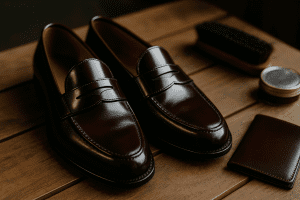
“Shell cordovan’s signature: mirror glaze, smooth vamp rolls, and color depth that lasts for decades.”
FAQs
Is shell cordovan stronger than calf?
It’s not “stronger” in all directions, but it is denser and more dimensionally stable, so it stretches less and resists surface creasing.
Why does it “bloom” with a white haze sometimes?
That’s natural wax migration to the surface. A brisk brush or buff removes it and boosts shine.
Can shell cordovan crack?
With abusive drying or severe bending, any leather can fail—yet shell’s compact structure and lubricated finish make cracking far less common than in grain leathers.
Does it need conditioner?
Rarely, and very sparingly. Most upkeep is brushing and light wax to maintain the glaze.
Why is it so expensive?
Limited yield (two small shells per hide), a long, labor-intensive tannage, and selective grading make supply tight and output slow.
Conclusion
Shell cordovan is a leather of process and patience. From its origin in the horse’s rump to months-long tanning, stuffing, leveling, dyeing, and glazing, every step exists to reveal a flawless, grainless face that can be polished to a mirror and rolled for decades without breaking. In shoes, it delivers poise and permanence; in wallets and straps, it offers a jewel-like finish that shrugs off years of handling. Care is elegantly simple—brush, buff, sparing wax, smart drying—and the reward is a surface that grows deeper and more luminous with time. For those who value materials that age forward, shell cordovan sits at the very top.