


Green Leather Certifications (LWG and Beyond): A Guide to Sustainable Leather Standards
Sustainability has become a key focus in the leather industry as consumers and brands alike push for more ethical and eco-friendly practices. In response, various “green leather” certifications have emerged to verify that leather is produced with reduced environmental impact and responsible methods. Labels such as the Leather Working Group (LWG) rating, ISO environmental standards, and others like OEKO-TEX® Leather Standard or the Sustainable Leather Foundation help signal better practices in tanning and sourcing.
But what do terms like “gold-rated tannery” really mean, and why should they matter to you? This guide breaks down the major sustainability certifications in the leather industry – from LWG’s medal ratings to ISO standards and beyond – and explains their significance for consumers and brands.
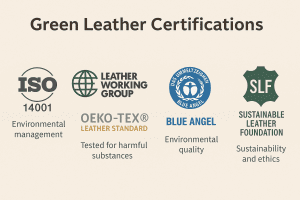
A quick guide to the world’s leading green leather certifications, helping consumers and brands identify responsible sourcing.
Leather Working Group (LWG) – Leading Environmental Certification
The Leather Working Group (LWG) is a leading international organization that promotes sustainable, environmentally friendly practices in leather manufacturing. LWG convenes brands, tanneries, chemical suppliers, and NGOs to develop a rigorous audit protocol for leather producers.
An LWG audit assesses a tannery’s performance across key areas – like water and energy usage, waste management, effluent treatment, chemical handling, and worker safety – to gauge its environmental compliance and continuous improvement efforts.
LWG Medal Ratings:
Tanneries that pass the audit earn a certification level: Bronze, Silver, or Gold, reflecting their degree of compliance with best practices. A “gold-rated” tannery is one that achieved the highest scores in the audit. LWG requires scoring at least 85% in all audited categories to attain Gold status (75% for Silver, 65% for Bronze). This means a Gold-rated tannery excels in environmental performance across the board – from minimizing pollution and energy use to proper waste treatment.
If any category falls below the Gold threshold, the tannery’s overall rating is capped at that lower level. Thus, a Gold rating indicates top-tier environmental stewardship. LWG certification has become a global benchmark, and many major brands now source predominantly from LWG-rated tanneries to ensure more sustainable leather supply chains.
ISO 14001 and Other ISO Sustainability Standards
In addition to industry-specific programs like LWG, many tanneries pursue ISO (International Organization for Standardization) certifications to demonstrate their commitment to sustainability and quality.
The most relevant is ISO 14001, an internationally recognized standard for effective environmental management systems. Achieving ISO 14001 certification means a leather manufacturer has a structured framework to identify and control its environmental impact, comply with regulations, set improvement targets, and be regularly audited for performance. For a tannery, this could involve systematic efforts to reduce water and energy consumption, cut emissions, manage waste responsibly, and prevent pollution in its operations.
Other ISO standards often seen in the leather industry include ISO 9001 (quality management) and ISO 45001 (health and safety management). While not “green” certifications per se, they indicate robust management systems that support overall sustainability goals. Together, ISO certifications signal that a leather producer operates with a high level of professionalism and accountability in both environmental and broader operational performance.
Leather Product Safety and Eco-Labels: OEKO-TEX® Leather Standard and Blue Angel
Not all certifications focus on the tannery’s processes; some address the safety and environmental impact of the leather product itself. Two notable labels in this category are the OEKO-TEX® Leather Standard and Germany’s Blue Angel eco-label:
- OEKO-TEX® Leather Standard:
A globally recognized testing and certification system for leather and leather goods at all production stages. It ensures that the finished leather (and even components like linings or trims) contains no harmful substances above strict limits. A leather item bearing the OEKO-TEX Standard 100 (Leather) label has been laboratory-tested for chemicals such as heavy metals, formaldehyde, dyes, and pesticides to verify it is safe for human use. - Blue Angel:
One of the world’s first environmental labels, originating in Germany, awarded to products meeting stringent eco-friendly criteria. While it’s not exclusive to leather, it can apply to leather goods (for example, eco-friendly upholstery leather or shoes) that meet high standards of environmental protection. Blue Angel criteria typically include using chrome-free tanning or other cleaner technologies, reducing pollution, and ensuring the product is long-lasting and low-impact.
Sustainable Leather Foundation (SLF) – Transparency and ESG in Leather
The Sustainable Leather Foundation (SLF) was established to drive sustainability across the entire leather value chain, from farms where animals are raised to the finished leather product.
The SLF takes a holistic approach: it evaluates leather manufacturers on Environmental, Social, and Governance (ESG) criteria and presents the results through a public Transparency Dashboard™. This dashboard allows consumers and business partners to instantly see a company’s performance in areas like environmental management, labor practices, community impact, and governance ethics.
SLF has its own audit standard and issues certifications to tanneries and leather goods makers. It uses a rating system similar to LWG’s medals – with “Gold Rated” as its highest level of recognition. An SLF Gold-rated company has demonstrated exceptional performance in sustainability and ethical practices in the leather industry.
Regional Sustainability Certifications: ICEC and CSCB
- ICEC (Institute of Quality Certification for the Leather Sector):
Based in Italy, ICEC is a specialized certification body exclusively for the leather industry. It offers a range of certifications covering environmental sustainability, ethical and social accountability, product quality, and traceability. Many premium Italian tanneries hold ICEC certifications to demonstrate excellence in these areas. - CSCB (Brazilian Leather Certification of Sustainability):
Brazil’s own sustainability certification, evaluating tanneries on environmental, social, and economic performance indicators. CSCB awards levels of achievement (Bronze, Silver, Gold, Platinum) based on scores across these three pillars. A Brazilian tannery with CSCB Gold status has excelled in meeting the criteria in all categories.
What “Gold-Rated Tannery” Means for Consumers and Brands
When a brand claims its leather comes from a “Gold-rated tannery”, it generally refers to the Gold level in the Leather Working Group audit (or an equivalent top-tier certification like SLF Gold or CSCB Gold).
For consumers, it’s reassurance that the leather was produced with the highest standards of sustainability – minimizing pollution, managing chemicals safely, and using resources efficiently.
For brands, sourcing from Gold-rated tanneries helps align with global best practices and meet eco-conscious consumer demand. Many brands now require LWG certification (or similar) for their suppliers, using it as both a sustainability benchmark and a marketing advantage.
Conclusion
The world of green leather certifications is about increasing transparency and accountability in an industry historically associated with heavy environmental impacts. Whether it’s an LWG Gold medal, an ISO 14001 certificate, an OEKO-TEX® tag, or a Blue Angel eco-label, these standards empower consumers to make informed choices and encourage continuous improvement among leather manufacturers.
By understanding what each certification stands for, you can recognize truly responsibly-made leather – and support the brands committed to a more sustainable leather industry.