


Understanding Leather Grades: A Guide to Quality and Selection
Leather is an incredibly versatile material, but not all leather is created equal. For artisans, hobbyists, and buyers of leather goods, understanding leather grades and types is key to choosing quality hides and crafting long-lasting products. In this guide, we’ll demystify how leather is graded (from Tannery A/B/C grades to industry variations), clarify terms like full-grain, top-grain, split (genuine), corrected grain, and bonded leather, and provide a handy comparison chart. You’ll also find real-world tips for selecting the right leather for various projects, plus artisan insights on hide sections, visible defects, and how tanning methods affect quality.
Leather Grading Systems Explained
Leather grading is the process of sorting hides by quality, mainly based on the presence of defects and the usable area of the hide. There is no universal grading system – each tannery or industry may use its own criteria. Generally, tanneries assign letter grades (A, B, C, etc.) to indicate the hide’s quality, with Grade A being the highest quality and Grade C or D the lowest. These grades refer to cosmetic appearance and yield, not the intrinsic strength of the leather. In other words, a lower-grade hide isn’t structurally “bad” leather – it simply has more scars, marks, or waste areas.
- Grade A: Prime quality hide with very few imperfections. Most of the hide is clean and usable, making it ideal for projects requiring large, unblemished pieces.
- Grade B: A decent quality hide with a moderate number of defects. Grade B might have a few more scars or scratches and a moderate amount of damaged or wasted area. It’s often a practical choice for many leather goods if you can work around some blemishes.
- Grade C (and below): Lower quality hide with significant imperfections. Grade C hides have more damage or waste, noticeable color variation, and many scars. “Utility” or D grade hides fall here as well, used for parts or projects where appearance isn’t critical. These hides are inexpensive but have a lot of unusable sections.
Most leather sold is often “Tannery Run (TR)”, which is a mixed batch of grades. Tannery Run means you’re getting a typical distribution of A, B, and C grades together – usually targeting an average of about B grade quality. This is a cost-effective way for vendors to sell hides and for buyers to get a mix of usable leather; you’ll have some prime sections and some with defects. If you specifically need the best sections only, you can expect to pay a premium for sorted Grade A hides.
Industry Variations: Beyond the common A/B/C letter grades, grading can vary by tannery and industry. Each tannery often has its own terminology or standards. For example, some tanneries use terms like standard, utility, and special instead of letters, based on the number of blemishes on a hide. Some systems use numeric grades; one traditional grading approach divides a hide into “Grade 1” through “Grade 4” based on which part of the cow it comes from. In that system, only about the top 15% of a hide (from the thick, tight-fibered back area) qualifies as Grade 1, with very few imperfections. The next 30% might be Grade 2 with a few more holes or defects, and so on, down to the stretchy belly areas as Grade 4. Despite different labels, the concepts overlap – the best leather comes from the most pristine, dense-fiber parts of the hide, while areas with more stretch or scars are graded lower. The key takeaway is that grading in the leather world is mostly about cosmetic yield: how much of the hide can be used without cutting around flaws.
Leather Quality Categories: Full Grain, Top Grain, Split & More
Aside from tannery grades, you’ve likely heard terms like “full-grain” or “genuine leather” in product descriptions. These refer to the type or cut of leather and how it’s processed, which also impact quality.
- Full-Grain Leather: This is the highest quality leather cut, taken from the top layer of the hide with the complete natural grain intact. The surface has not been sanded or corrected, so it shows the hide’s original grain patterns and markings. Full-grain leather often displays “imperfections” like small scars or wrinkles – which are actually valued as signs of character and authenticity. Because the grain layer is intact, full-grain is very strong and durable; the densely packed fibers in the grain give it excellent tensile strength. It also develops a rich patina over time – the surface ages beautifully with exposure and handling, deepening in color and luster.
- Top-Grain Leather (Corrected Grain): The term “top-grain” often means leather that has been buffed or sanded to remove natural imperfections – what professionals call corrected grain leather. This leather still comes from the top layer of the hide, but the very surface has been corrected: scars or blemishes are smoothed out, and an artificial grain pattern and finish are applied for a uniform look. Corrected top-grain leather is slightly more processed than full-grain but still high quality and durable. The trade-off is mainly aesthetic and tactile: corrected grain leather won’t develop patina as much and has less breathability than unfinished full-grain.
- Split Leather (Genuine Leather): When a thick cowhide is processed, it’s often split into layers to reach the desired thickness. The lower layer (the underside of the hide) is called the split. Split leather has no natural grain – it’s essentially the fibrous bottom part. To make it usable, tanneries usually emboss a grain-like texture on the split and finish it with dyes or polyurethane. This is commonly marketed as “genuine leather”. In quality terms, split/genuine leather is inferior to top-grain because it’s missing the strong grain layer.
- Bonded Leather: Bonded leather is made by taking leather scraps, fibers, and dust, grinding them up, and bonding them together with adhesives onto a fabric backing. The result is a material that might look like leather from a distance but is typically only a small percentage actual leather. Bonded leather is the lowest grade of leather available – essentially a reconstituted product. It may look nice on day one but has very poor durability and tends to peel and crack after limited use.
Comparison Chart: Leather Grades and Characteristics
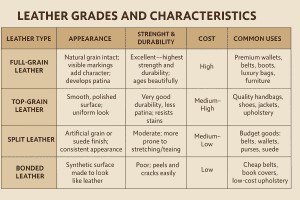
Leather grades compared side-by-side, showing how each type differs in look, durability, cost, and best applications.
Real-World Tips for Choosing the Right Leather
- Match leather to project use: Belts and straps → full-grain veg-tan; jackets → chrome-tanned top-grain; budget items → split leather.
- Look for clear labeling: “Genuine leather” usually means split leather. If it’s full-grain, brands will state it proudly.
- Consider environment and wear: Chrome-tan resists water better; veg-tan is ideal for tooling and patina.
- Don’t fear natural markings: Scars and grain variations add uniqueness to artisan products.
- Test temper and stretch: Back and shoulder cuts are firmer and stronger; belly cuts are looser and stretch more.
Artisan Insights: Hide Sections, Defects, and Tanning Method
Hide Sections:
- Back/Butt: Densest, strongest fibers – ideal for straps and belts.
- Shoulder: Thick and versatile, slightly more flexible than back.
- Belly: Loose fiber structure, more stretch – best for small goods or practice.
Defects and Yield:
Match grade to pattern size. Large panels need higher grades; small items can be cut from lower grades if you avoid flaws.
Tanning Method Impact:
- Vegetable-tanned: Firm, moldable, ideal for tooling and patina.
- Chrome-tanned: Softer, more water-resistant, available in vibrant colors.
- Combination-tanned: Mixes benefits of both.